Singapore kueh dadar pandan coconut pancake (Vegan)
An easy kueh dadar recipe which doesn't require you to hunt down freshly grated coconut! Also my recipe for this Perankaan kueh has no eggs so perfect for vegans!
- Prep time
- 10 min
- Cook time
- 1 hr
- Yield
- 4 servings
- Difficulty
- HARD
Ingredients
Quantities are shown as originally provided.
- 250 g dessicated coconut
- 75 g coconut milk
- 100 g Gula Melaka (palm sugar)
- ⅓ Cup water (or 79g)
- A few pandan leaves, bruised and knotted (Optional)
- ½ teaspoon Salt
- 2 Tablespoons flax seed powder
- 6 Tablespoons water (for the flax egg, as above)
- 2½ Cups flour (300g) (Hong Kong or all-purpose)
- 1 Tablespoon tapioca flour
- 2⅓ Cup Pandan Juice (550ml)
- 100 ml coconut milk (see above for making coconut milk from coconut cream)
- ¼ teaspoon salt
- Neutral vegetable oil, a few tablespoons
Instructions
- 1
For the flax egg: mix the ground flax seed/ flax seed powder with the 6 tablespoons of water and leave for 15 minutes to form a flax egg. (Make sure you stir well.)
- 2
Sift the tapioca starch and wheat flour. Add the salt and mix well. Slowly mix with the pandan juice and coconut milk- do it in stages, if not the batter will be lumpy which is not good (i.e. pour 1/3 the liquid in, mix, another 1/3, mix again etc)
- 3
Add the flax egg and whisk well.
- 4
Leave to rest in the fridge for 30-60 minutes
- 5
Add the 75g of coconut milk to the dried grated/ dessicated coconut to rehydrate it as much as possible and stir. Skip this step if you're using freshly grated coconut.
- 6
Grate, roughly chop or pound the gula melaka. Basically you want to break the block down into smaller chunks so it will dissolve into the coconut more easily later.
- 7
Add gula melaka, water, salt and pandan (knotted if using) into a pot. Bring to a boil and stir.
- 8
Once boiling remove the pandan and add the rehydrated coconut (Make sure you scrape all the coconut milk into the pot too.) Keep stirring till slightly dry. It will take a while to cook off the water so don't be lazy. People can tell when the filling is too wet and the kueh isn't as nice. Once it's at your desired consistency, turn off the heat, give it another stir, and leave to cool
- 9
Take the batter out of the fridge and sieve it. This helps to remove any lumps in the mixture. If you think it's overkill, check above for a photo of a wrapper made with sifted flour but unsieved batter.
- 10
Turn the heat on to low-medium and heat the pan. It may take a while for the pan to heat up if the bottom is quite thick.
- 11
Pour some oil into a bowl and use a kitchen towel to oil the surface of the pan. (You don't want the crepe to stick!)
- 12
Once hot enough, use the ladle to stir the batter- it needs to be stirred before each crepe- then pour 1 ladle-full of batter into the pan. At the same time, use your other hand to swirl the pan so that the batter forms a nice thin circle. If you find this challenging, you can use your ladle to move the batter on the pan to form a circle (make sure your ladle is heat-proof.)
- 13
Let the crepe cook- it will take about 2 minutes for the first side. When the batter has changed colour and when the edges start peeling off the pan, flip it and cook the other side for 30 seconds. Put the cooked wrapper on the parchment-paper lined baking tray. If it looks like crap, don't be discouraged- the first 1 or 2 crepes are usually sacrifices to test whether the pan is hot enough etc. If they can't be used to wrap the filling, you can always dip them in this gula melaka coconut caramel sauce!
- 14
If necessary, use the kitchen paper to oil the pan again and repeat the above steps till all the batter has been used up. Don't forget to stir the batter before ladling each crepe! Place the subsequent crepes next to the previous crepe (and not on top of)- when you've run out of space, place another sheet of parchment paper on top of the bottom crepes, and start again. (If you put the crepes on top of each other they may steam, stick and tear.) (You may need to lower the heat after you've made a few crepes.)
- 15
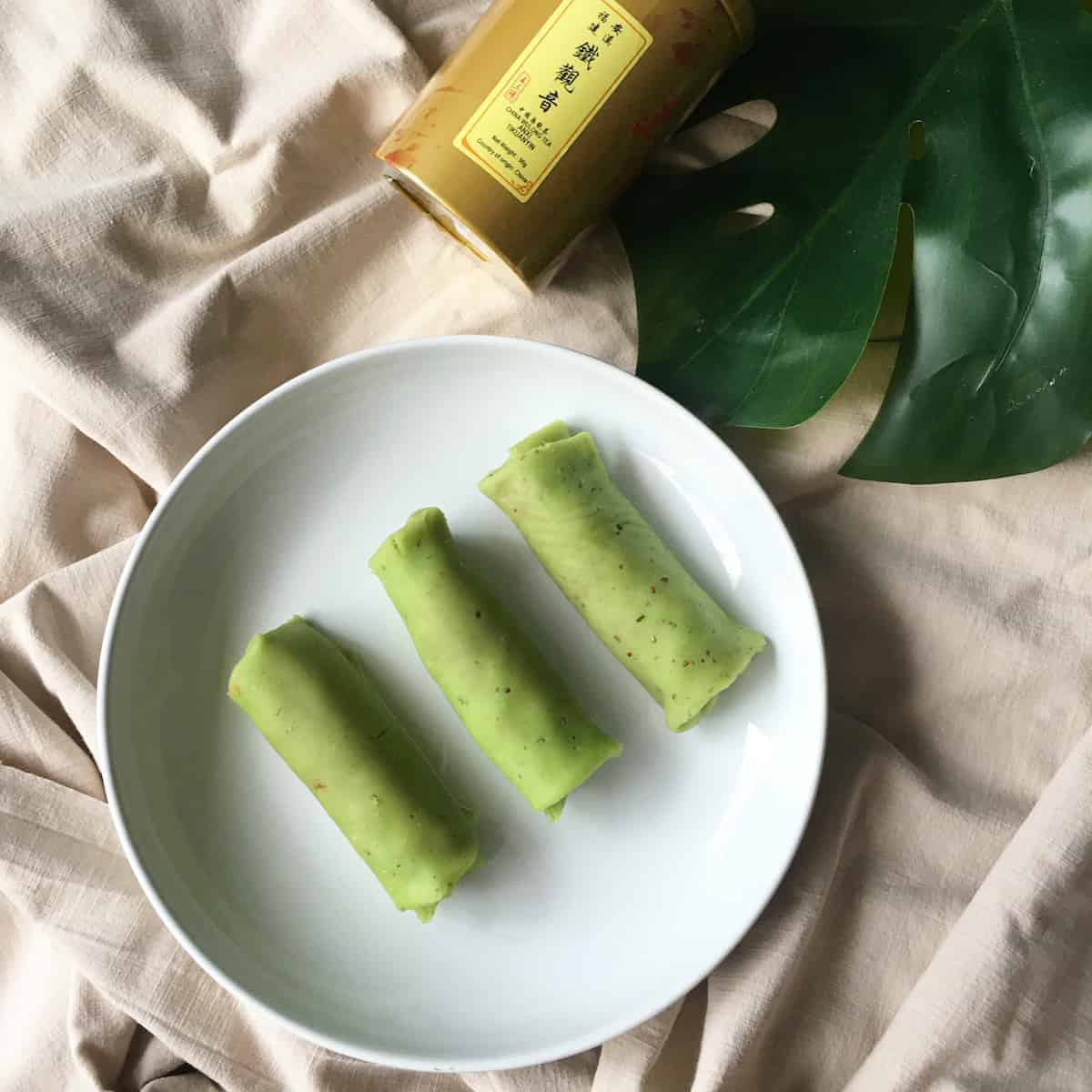
After the wraps and filling are cooled, it's time to fold the kuehs! Place some filling in the centre of the wrap, towards the bottom, then fold the left and right edges in. Next, fold the bottom edge up- it's kind of like folding an envelope- before rolling the wrap to the top. You should get a cylindrical shaped green snack.