Mediterranean Slow Roast Duck with Olive Sauce
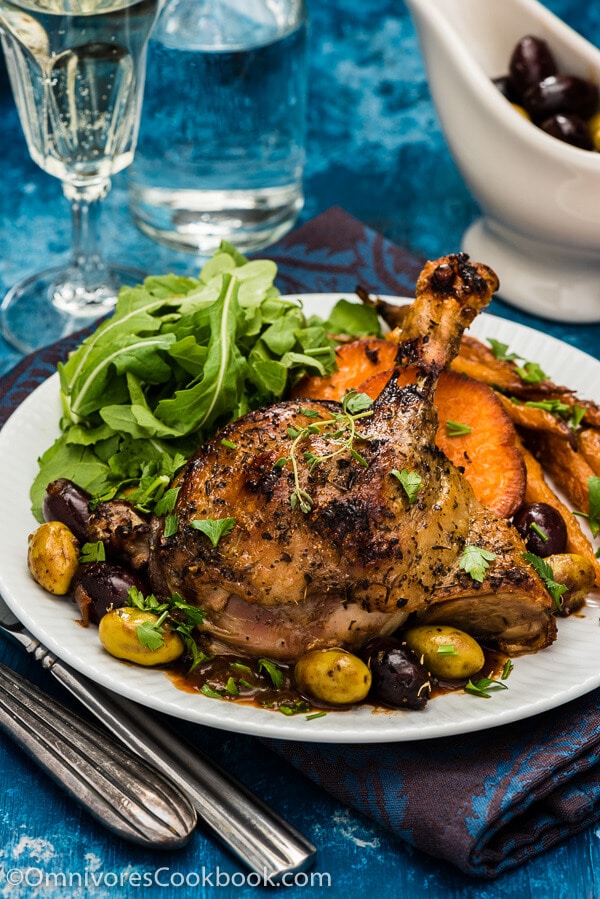
This slow roast duck features very tender meat, super crispy skin (just like confit), and a sumptuous olive sauce. It will take quite some time and effort to cook, but it’ll definitely be a highlight on your dinner party’s menu.
- Prep time
- 15 min
- Cook time
- 4 hr 10 min
- Yield
- 4 servings
- Difficulty
- HARD
Ingredients
- 1 whole (5 pound / 2.3 kg) young duck
- 2 medium sized onions (, coarsely chopped)
- 1 large celery rib (, sliced)
- 8 garlic cloves (, halved)
- 1 and 1/2 tablespoons fresh thyme (, chopped (or 2 teaspoons dried thyme))
- 1/4 cup parsley (, coarsely chopped (plus extra to garnish))
- 2 bay leaves
- 2 tsp sea salt
- 1 tsp freshly ground black pepper
- 1 tsp herbes de Provence
- Neck (back, wing tips, heart, and liver of the duck (*see footnote 1))
- 1 medium sized onion (, sliced)
- 1 tbsp tomato paste
- 1/2 cup dry white wine
- 1/2 tsp sugar
- 1 cup homemade poultry stock ((or boxed chicken stock))
- Salt and black pepper to taste
- 1 and 1/2 cups pitted olives
- 1/4 tsp herbes de Provence
Instructions
- 1
Preheat oven to 475 degrees F (245 C). Prepare a 9 by 11-inch roasting pan.
- 2
Spread onion, celery, cloves, thyme, and parsley in the pan to make a bed for the duck.
- 3
Halve duck according to this YouTube video. Save the neck, back, wing tips, heart, and liver for the sauce.
- 4
Combine sea salt, black pepper, and herbes de Provence in a small bowl.
- 5
Prick the duck skin every 1/2 inch with the tines of a fork. Rub both sides of the duck with the sea salt mixture. Set duck on top of the veggies, skin side up.
- 6
Roast uncovered for 10 minutes.
- 7
Reduce the oven temperature to 275 degrees F (135 C).
- 8
Cover the pan with aluminium foil. Return the pan (you don’t need to wait until the oven temperature drops to 275 F) to bake until the duck turns very tender, about 3 and 1/2 hours.
- 9
Prepare the sauce while baking the duck.
- 10
Turn off the oven. Let the duck sit in the oven for another 30 minutes.
- 11
Carefully transfer the duck to a work surface. The duck will be very tender now and the meat will fall apart easily with a simple pull. Remove loose bones by hand. Discard the bones and the veggies in the pan. Save 1 teaspoon duck fat for later use. (Footnote 2)
- 12
Quarter the duck - use a sharp chef’s knife to cut the duck into two equal pieces, between the breast and thigh. As most of the bones have been removed, it should be easy to slice the duck without affecting its shape.
- 13
Wrap each piece of duck with aluminum foil to keep it moist until you’re ready to serve it. If you’re making the duck a day ahead, place the wrapped duck in an air-tight container and store in the fridge. If storing longer, place the container in the freezer.
- 14
Add the bones, heart, and liver of the duck into a nonstick skillet, skin side down. If you are not using a nonstick pan, grease the pan with some oil before adding the bones. Cover and cook over medium low heat until the all pieces are browned.
- 15
Add onion. Continue cooking and stirring until the onion is browned, about 10 minutes.
- 16
Add tomato paste. Cook and stir until slightly charred.
- 17
Pour white wine into the skillet and quickly scrape off the brown bits with a spatula.
- 18
Add sugar, stock, and 3 cups water. Cook over medium high heat until boiling. Turn to medium low heat and simmer for 1 hour.
- 19
Strain the sauce and transfer to a fat separator. Discard the fat and return the stock to the skillet.
- 20
Cook over medium high heat until the sauce reduces to 1 cup.
- 21
Transfer the sauce to an air-tight container and store in fridge.
- 22
About 10 minutes before serving, preheat broiler, line a baking tray with aluminum foil, and spray with oil. Start reheating the sauce.
- 23
Generously season duck with salt and pepper. Place on the baking tray, skin side up. Dab the saved duck fat on top.
- 24
Transfer the sauce to a sauce pan. Add olives and cook until the sauce is heated through. Adjust seasoning with salt, pepper, and herbes de Provence. (Footnote 3)
- 25
Crisp and heat the duck 10 inches under the broiler. You should watch closely during this step, because the duck will heat up and char very quickly. Pull the duck from the oven as soon as the skin is crisped.
- 26
Transfer the sauce with olives onto plates. Place the duck on top and garnish with parsley. Serve warm as main.