Pandesal (Filipino Bread Rolls)
Classic and much-loved, pandesal (Filipino bread rolls) are crispy on the outside and wonderfully soft on the inside. Make them at home easily with this recipe, and more importantly, learn how best to adapt them to your own tastes and ingredients with detailed notes on the flour, yeast, shaping methods, baking techniques, and much more.
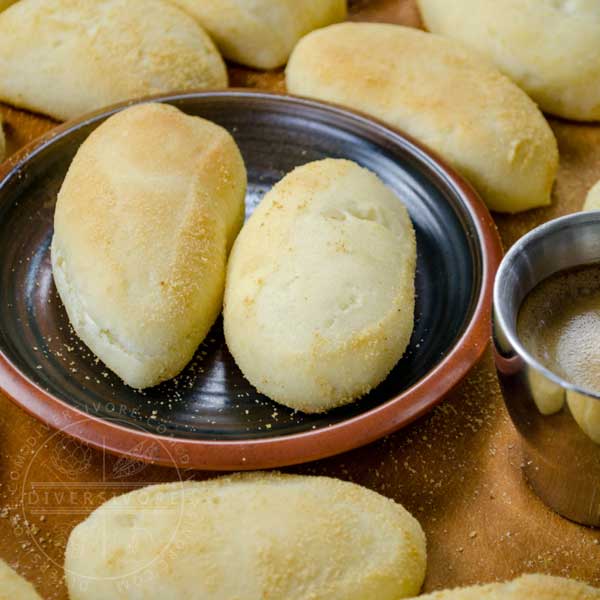
- Prep time
- 30 min
- Cook time
- 20 min
- Yield
- 24 servings
- Difficulty
- HARD
Ingredients
- 1.25 cup milk (preferably full-fat)
- 1/3 cup granulated sugar
- 2 tsp active dry yeast ((see note for instant yeast))
- 4.5 cup all purpose flour (plus more as needed)
- 1 tsp salt
- 2 tbsp butter (softened)
- 2 large eggs
- 1 tbsp vegetable oil (plus more for oiling the bowl)
- 1 cup breadcrumbs (fine/dry (see note))
Instructions
- 1
Warm the milk briefly in a saucepan or microwave. It should be a little warmer than room temperature, but not too hot (hot milk will kill the yeast).
- 2
Mix 1 teaspoon of the sugar into the milk, then sprinkle the yeast over the surface. Allow the yeast to bloom for 10 minutes.
- 3
Crack the eggs into a small bowl, mix with a fork, and set aside.
- 4
Combine the flour, salt, and remaining sugar in a bowl.
- 5
Combine the the proofed yeast/milk, softened butter, eggs, and oil in the bowl of a stand mixer equipped with a dough hook (see note below for hand-kneading instructions).
- 6
With the mixer running at a low speed, add a little of the flour/sugar mixture to the bowl. Repeat until all of the ingredients are combined, scraping down the sides of the bowl as needed.
- 7
Increase speed a bit and mix until dough is well-combined, springy/elastic, and forming a ball around the dough hook (4-5 minutes). If the dough is overly wet and/or won't ball around the dough hook, add flour (a little at a time) and continue to mix until the desired consistency is met.
- 8
Turn the dough out into an oiled bowl, cover with plastic wrap, foil, or a damp cloth, and proof until doubled in size (30-60 minutes, depending on temperature, etc.). The finished dough should spring back nicely when gently poked with a finger.
- 9
Gently punch down the dough, then turn it out onto a lightly floured board.
- 10
Form the dough into a rough log shape. Cut this into three equal pieces (a dough knife/bench scraper is easiest for this).
- 11
Option 1 - Cut/oval pandesal - Press 1/3 dough portion into a long rectangle. Form baston (see note) by rolling one corner over, then tucking the edge into the center. Repeat with the other edge. Roll this baston in bread crumbs. Cut the baston at an angle into 3 cm pieces (just over 1 inch). Dip the cut pieces back into breadcrumbs, then space out on a baking sheet covered in parchment paper.
- 12
Option 2 - Round pandesal - Form the dough into one or more long cylinders. Cut small, even pieces of dough from the main portion, then shape these into balls. Roll or dip the balls in breadcrumbs, then arrange them on a baking tray. Space out for crusty rolls, or crowd together for tray-bun style pandesal.Note: A small kitchen scale makes this method much easier and more consistent. Aim for 40 g for smaller rolls, 50 g for larger rolls.
- 13
Cover and proof again until the rolls have risen by about 50% (generally 30-40 minutes).
- 14
Preheat oven to 325°F (160°C). Optionally, place a couple of small, shallow pans of hot water in the oven to increase the humidity.
- 15
Bake for 20-25 minutes, or until lightly golden. Smaller, evenly spaced rolls will take less time than larger and/or closely spaced (tray-bun style) rolls.
- 16
Remove from oven and cool. If you've made tray bun-style pandesal, I strongly recommend turning them out onto a wire rack to cool, as they tend to get soft/soggy sitting on the pan.